Biomass Pelletizing Line
GREENPOWER offers design and supply of pelletizing lines for processing wood and agricultural biomass. Line throughput is scalable across a wide range, from compact solutions producing 500 kg/hour to industrial-scale systems producing 10 tons/hour of finished pellets.
Flow chart of pelletizing line
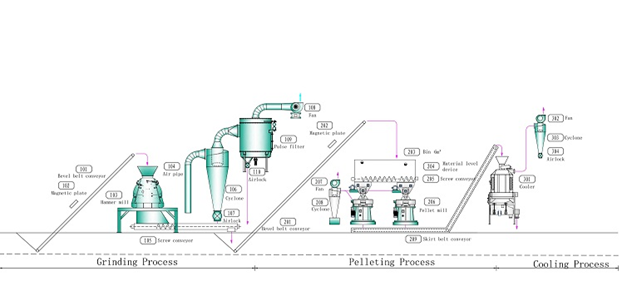
Below are the main components of a typical pelletizing line (by blocks):
1. Grinding process:
| Code on the diagram | Name | Function |
| 101 | Inclined belt conveyor | Feeding raw materials to the crushing section |
| 102 | Magnetic separator (magnetic plate) | Removal of metal inclusions |
| 103 | Hammer crusher | Crushing raw materials to the required fraction |
| 104 | Pneumatic transport air duct | Transport of crushed material by air |
| 105 | Screw conveyor | Dosed feeding/transport of material |
| 106 | Cyclone | Separation of product from air |
| 107 | Airlock (Rotary Valve) | Unloading without air suction |
| 108 | Fan | Generation of Negative Pressure / Airflow |
| 109 | Pulse bag filter | Air purification from dust |
| 110 | Airlock (Rotary Valve) | Unloading dust/material from the filter |
2. Pelleting process:
| Code on the diagram | Name | Function |
| 201 | Inclined belt conveyor | Feeding material to the granulation hopper |
| 202 | Magnetic separator (magnetic plate) | Additional protection of the granulator from metal |
| 203 | Storage Hopper | Buffer stock for stable supply |
| 204 | Material level sensor | Bunker filling control |
| 205 | Screw feeder | Uniform feed to the granulator |
| 206 | Pellet press | Pellet forming through a die |
| 207 | Fan | Extraction of vapors/dust, maintaining aspiration |
| 208 | Cyclone | Separation of dust/particles from air |
| 209 | Belt conveyor with sides (scraper/skirt) | Transport of hot pellets for cooling |
3. Cooling process:
| Code on the diagram | Name | Function |
| 301 | Counter-flow cooler | Cooling and stabilization of pellets |
| 302 | Fan | Cooling air supply/exhaust |
| 303 | Cyclone | Separation of dust from air after cooler |
| 304 | Airlock (Rotary Valve) | Unloading dust/material from a cyclone |
Pellet production process
The typical process includes the following stages:
- Raw material reception and feeding onto the line.
- Magnetic separation to remove metal inclusions.
- Crushing to a processable size fraction (typically 3–5 mm for wood-based materials).
- Aspiration and dust collection (cyclone + bag filter) for cleanliness and safety.
- Buffering in the hopper and metered feeding to the pelletizer.
- Granulation: pressing the material through a ring die with rollers.
- Pellet cooling to near-ambient temperature to achieve strength.
- If necessary: screening (sifting out fines) and packaging/storage (optional according to the project).
Acceptable raw materials for pelletizing
The line can process a wide range of biomasses. The most common options are:
- Wood sawdust and shavings (coniferous/deciduous).
- Fine-grained wood chips after crushing.
- Bark (with restrictions on ash content and tool wear).
- Biomass: straw, husks (rice, sunflower), stalks, corn residues – subject to line composition agreement.
- Sugarcane cake or bagasse.
The key requirement for stable granulation is optimal raw material moisture content before the press, typically 12–18% (selected based on the raw material type). For higher moisture content, a drying module is added to the line.
Pellets Application Options
Pellets can be used as:
- Fuel for boilers and industrial heat generators.
- Raw material for producing charcoal or biochar.
- As a carbon source or feed additive.
Pellets pyrolysis in BIO-KILN units produces high-quality BIOCHAR, suitable for industrial and agricultural applications. This provides additional value: pellets become standardized feedstock for a controlled pyrolysis process and consistent end product quality.